

Draw Your Revolution.
What would your life look like in three panels? On the life and defiant art of Marjane Satrapi

NOTE TO READERS: Welcome to the next chapter of our community: The Sharpening, a creative resistance network using creative practices for political catharsis. Everything from Listening in the Dark is still archived here, and you can read about what this new chapter means—and where we’re headed—in our introductory post HERE.
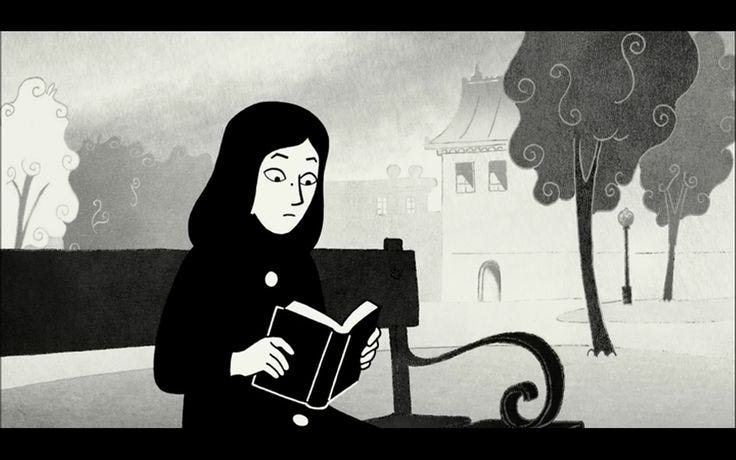
One of the first graphic novels I ever owned as a young adult was Persepolis by the great Iranian-French writer Marjane Satrapi, who died this week at the shockingly young age of 56.
Persepolis was different from other YA graphic novels I had been given to read over the years in that it demanded something of me. It didn’t just tell a story—it bore witness to one. In stark black and white, with no color to soften the blow of its story, it asked me to sit inside a child’s confusion about revolution, exile, and survival, and to understand that history is not something that happens to countries, it happens to the little girls who live inside them.
Persepolis tells the story of Satrapi’s own childhood in Tehran, her life from ages six to fourteen, spanning the fall of the Shah, the triumph of the Islamic Revolution, and the long, grinding devastation of the Iran-Iraq War. She was the only child of committed Marxist parents, intellectuals who had marched against the old regime and watched in horror as the new one rose to take its place. She was also, improbably, the great-granddaughter of one of Iran’s last emperors. Satrapi grew up suspended between worlds—between the home where her parents played forbidden card games and drank wine behind drawn curtains, and the world outside, where girls were made to wear veils and women could be beaten for the wrong shoes. The book’s genius is that she renders the telling of all this through the eyes of a child who is furious, funny, bewildered, and absolutely unbroken.
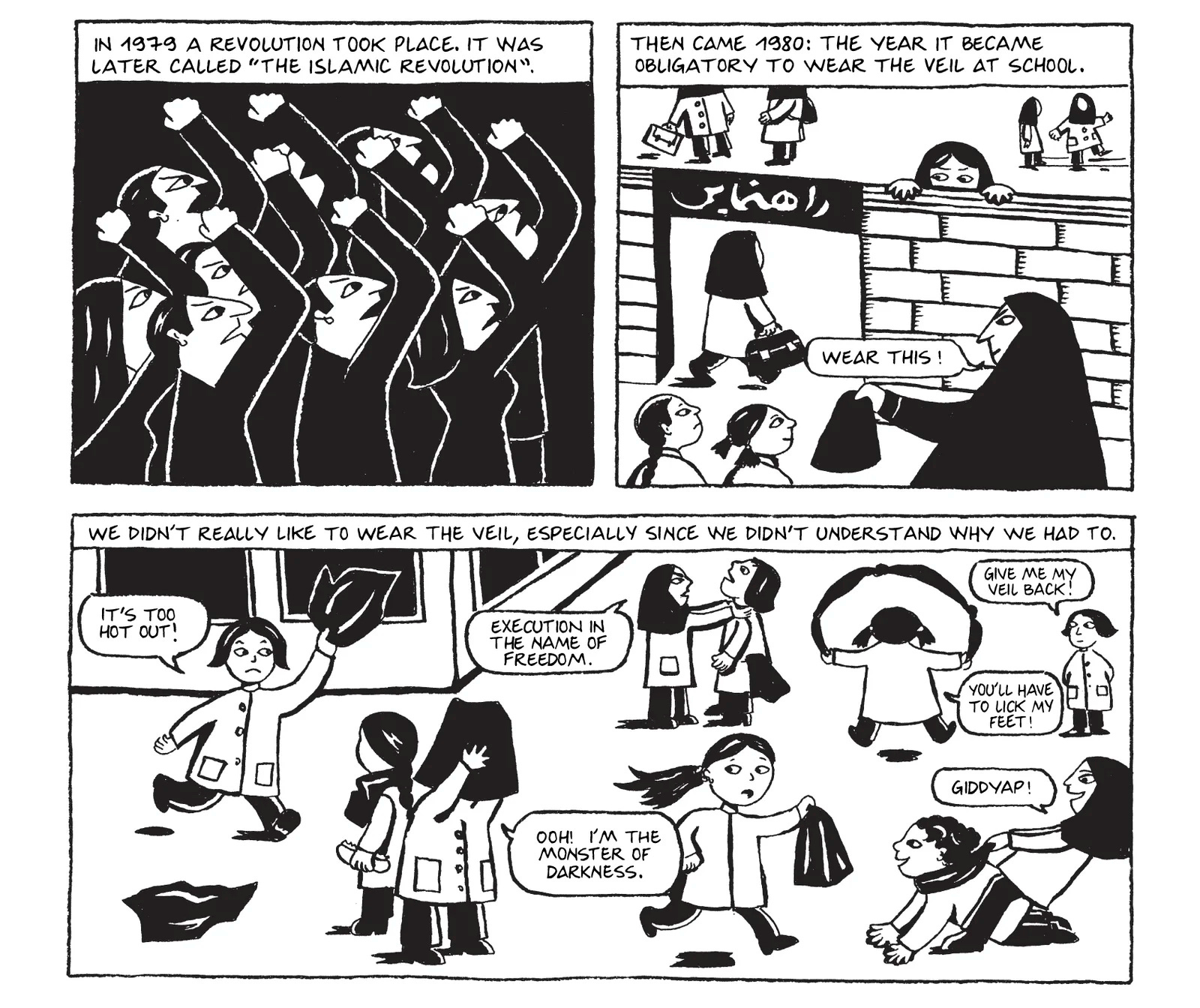
Satrapi was born in Tehran to parents who were, as she would later say, too idealistic for their own good. When the revolution came, she was ten years old. By fourteen, her outspokenness—she once hit her school principal for confiscating her jewelry—had made her a liability in a country that punished girls for exactly that kind of fire. Her parents made the agonizing decision to send her to Vienna alone. She would spend years in Europe—lost, homeless at points, desperately poor—before eventually making her way to France, where she made her home, her art, and her name.
She remained one of the most vocal critics of the Iranian government anywhere in the world—editing Woman, Life, Freedom after Mahsa Amini was killed by Iran’s morality police in 2022, and refusing France’s Légion d’Honneur as recently as 2025, on the grounds that France had been hypocritical in its relationship with the Iranian regime. She had no patience for ornamental solidarity. She wanted the real thing.
Satrapi inspired a generation of girls and young women with her punk refusal to be palatable—a teenager who wore Nike sneakers and Iron Maiden t-shirts under her mandatory veil, who listened to forbidden music, who smoked, drank, fell in love recklessly, and made art out of all of it. She showed us that the self could not be fully legislated. That even under a theocracy, something in you could remain stubbornly, defiantly yours. Her black-and-white panels weren’t just a stylistic choice; they were a political one. This past week, her family said she died “of sadness”—a little more than a year after losing her husband, the love of her life. It has a medical name: Takotsubo cardiomyopathy—broken heart syndrome—a sudden weakening of the heart triggered by acute grief. (I wrote about this phenomenon in an essay for Listening in the Dark newsletter in the spring of 2024 on having to wear a heart monitor for a couple weeks.)
What we can learn from Satrapi’s extraordinary life and art is that the personal is never just personal. That a child’s drawing in black ink—crude, funny, devastating — can outlast a regime. That telling your own story, honestly and without permission, is a political act. That exile doesn’t have to mean silence. That punk isn’t a genre; it’s a posture toward power. Satrapi taught a generation of young women that their confusion and their rage were not embarrassing things to be managed—they were the material. They were the whole point.
This week’s Creative Call to Action: In honor of Marjane Satrapi, draw your revolution.
Write, sketch, or make something in black and white this week. No color required. Satrapi proved that a single ink line can hold an entire childhood, a political era, a country lost and found. What would your memoir look like in three panels?
Don’t worry about your skill level as an artist— this can and should be scrappy, messy, fun, raw. Use stick figures if you want to! It can be as minimalist or DIY as you want it to be.
As always, post what you made and tag me so I can share it with our community! Take a picture and post it in the comments below, in Substack’s Notes, on Intagram or Threads.
Extra Credit: Forward this post to someone whose creative call to action you want to see manifested in the world, ask them to JOIN US!
Substack Lives this summer, WITH DATES AND TIMES (Thank you Sam for asking for this!) :
June 10th @ 2pm ET: A conversation with tech-founder and former META consultant Jesse Nolan on how to fix the left’s branding woes
June 15th @ 2pm: What we can (and should) learn from the sex lives of animals with the great granddaughter of Eleanor Roosevelt herself, Perrin Roosevelt Ireland
July 9th @ 2pm ET: How to wield artistry in a weaponized world with multi-hyphenate and award-winning poet, Mahogany Browne.
Upgrade to a paid subscription to hang in the comments and ask questions of our amazing guests, as well as catch up on the replays of recent interviews with guests like Roxane Gay and R.O. Kwon!
✨PLUS:✨ I’m hosting a smaller more intimate live gathering over Zoom for our paid subscribers this summer with the brilliant poet, essayist, and recipient of the NEA, Maggie Smith! Come join us to talk about finding beauty and meaning in everyday life, writing through loss and change, and the craft of making art that endures, how to infuse poetry into your art and daily life, and we’ll even get to spend a little time actually working on a poem together. Sunday July 12th at 2pm ET. (Detail and Zoom Link Will be emailed to paid subscribers the morning of!)
Upgrade to a paid subscription to hang in the comments and ask questions of our amazing guests, as well as catch up on the replays of recent interviews with guests like Roxane Gay and R.O. Kwon!
The Sharpening is a reader-supported newsletter run by me, Amber. Upgrading to a paid subscription keeps it going—and growing. Your support lets me dedicate real time to crafting original, timely creative prompts and bringing in some of the most compelling artists working today for interviews and webinars.
With a paid subscription, you get:
Access to all Substack Lives and Zoom webinars featuring artists whose work sits at the intersection of the political and the personal.
The ability to comment, ask questions, and engage directly with featured guests— plus recordings of everything, so you never miss a session.
Invitations to in-person meetups and early access to virtual and in-person events.
Behind-the-scenes updates on my upcoming projects, book tours, and events— plus three years of archived content from my previous newsletter.
This testament to this artist ripped through to my soul. Thank you.
In 3 Panels: 1) I would be a wild thing. Untamed. Ferocious. Bleeding. Chunks of me lying on an empty highway, my middle fingers burned to the bone yet still pointing at the universe 2) I'm a shriveled mother, dragging myself with two children in tow through a decimated landscape. A dog by my side, tears streaming in my wake; though hidden from my face 3) Backdropped by a large ocean wave, my body sheds visible ash. It has lost organs and false youth. The eyes hold history... torn fingernails, honesty, venom, and a drop of hope. The kind of hope earth mother has when she sees an eaglet take its first breath *not painted in actual oils, though maybe some day ;)